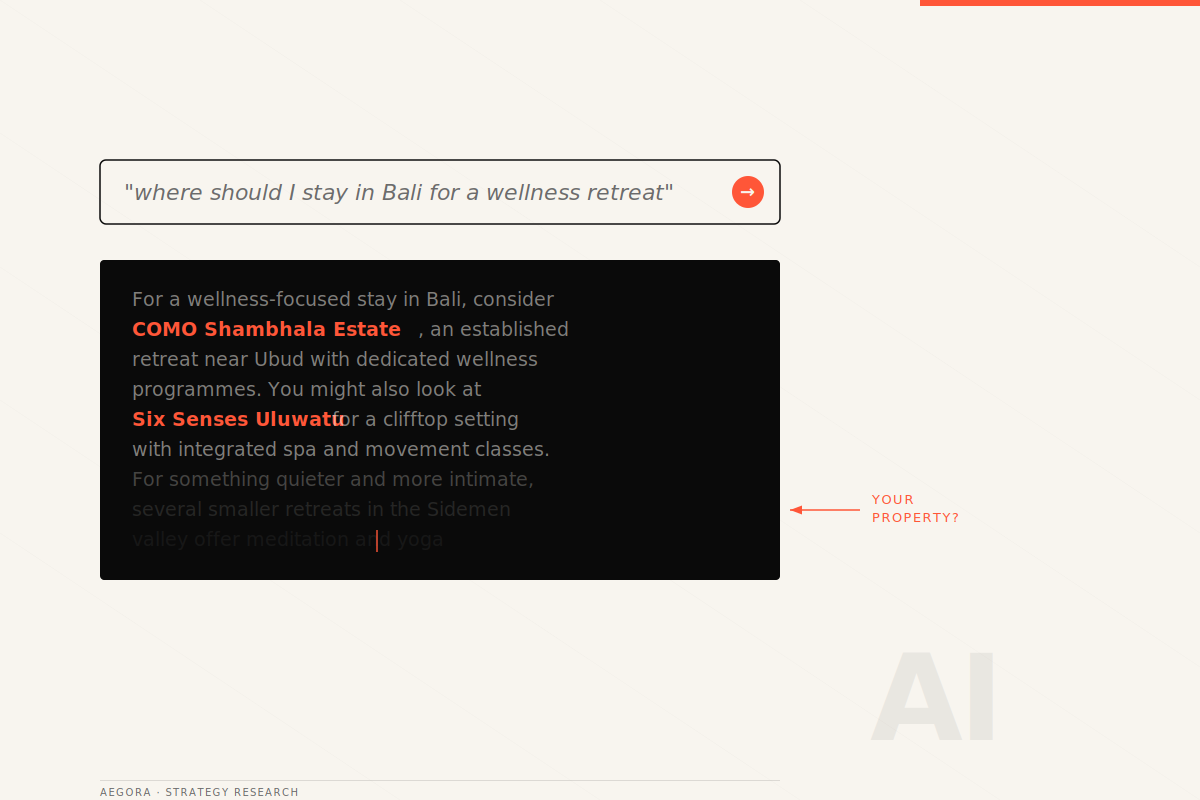
A guest in Sydney, Munich or Singapore who wants to find a wellness retreat in Ubud, a design hotel in Lisbon or a tasting menu in Bangkok no longer behaves the way they did in 2019. The Google search is still there, but next to it now sits a conversation with ChatGPT, Gemini or Perplexity. The traveller types a paragraph describing what they want, and the model returns three or four recommendations. The guest then verifies those names elsewhere and books through the channels they always have.
This is the part of the shift that is real. The other part, the suggestion that travellers are now booking through AI, is not. The data is clear on this division, and it is the division operators in our sectors should plan around.
The split worth paying attention to
In April 2026, Expedia Group published a study conducted by YouGov of more than 5,700 adults in the United States, the United Kingdom and India, with fieldwork between 10 and 25 March 2026. 53% of respondents said they were comfortable letting AI suggest travel options, and 48% said AI had helped them discover destinations they would not otherwise have found. Only 8% of travellers in the United States and United Kingdom said they actually relied on AI chatbots to plan a trip, against 59% who still used search engines and 49% who used online travel agencies. 68% said they preferred to book with trusted brands rather than with an AI tool. The report named the gap directly in its title: travellers embrace AI for planning but rely on trusted brands to book.1
A separate global survey conducted by Kaspersky in partnership with Toluna in summer 2025, with 3,000 respondents across 15 countries including Indonesia, Malaysia, India, China, the United Arab Emirates and Saudi Arabia, found that 28% of travellers actively used AI to plan trips. Among those who did, 96% were satisfied with the results, 70% used AI to find events and activities, 66% to choose accommodation, and 60% to identify restaurants.2
The size of the AI discovery channel relative to existing channels is not yet well established. Adoption percentages across studies vary widely depending on the question asked, the population sampled, and whether the survey measures occasional use or sustained reliance. What is clearer is the direction: usage is growing, satisfaction among users is high, and the largest commercial platforms in travel are repositioning around the assumption that AI-mediated discovery will be a meaningful share of the funnel within two to three years. The honest reading is that adoption is real, accelerating, and concentrated among a minority of travellers who use AI intensively and report high satisfaction. Operators do not yet need to treat AI as their primary discovery channel. They do need to know what the channel currently says about them.
None of the studies cited here was conducted specifically in Southeast Asia. The Expedia survey covered the United States, the United Kingdom and India. The Kaspersky survey included Indonesia and Malaysia among its 15 markets but did not break out their results separately. The mechanics described below, however, are properties of the underlying models rather than of the markets surveyed. ChatGPT in Sydney and ChatGPT in Singapore are the same system answering different questions, and the citation patterns of OTAs, review platforms and travel blogs are global properties of those sources. Southeast Asia's particular exposure lies elsewhere: in the high concentration of independent and boutique operators relative to chain brands, especially in Bali, Phuket, Lombok, Hoi An and Siem Reap, which makes the disadvantages described below more material here than in markets dominated by major hotel groups.
How the model decides what to recommend
For two decades, discovery in our sectors has been mediated by Google, Tripadvisor, Instagram and the major OTAs. Operators understood the mechanics of each. They knew which keywords mattered, how to manage reviews, how to time Instagram posts. Even a small Canggu villa knew that a strong Google ranking and a respectable Tripadvisor score would surface it in front of the right traveller.
The mechanics inside a language model are not the same. When ChatGPT answers a query such as "where should I stay in Bali for a five-night wellness reset", it does not return a ranked list of websites. It generates a paragraph. To do so, it draws from a basket of sources it considers credible and relevant. The model decides which property names to mention, in what order, and with what description. The property has no visibility into this process and limited influence over it.
A natural objection at this point, from any operator who has invested in digital marketing for the past decade, is that this sounds like work they are already doing: managing OTA profiles, maintaining Tripadvisor reviews, ensuring directory consistency. The work overlaps but is not the same. Traditional digital marketing has been organised around ranking in a Google search results page or appearing in an OTA filter. AI optimisation is organised around being cited inside a generated paragraph, where ranking is replaced by source selection, and where the model rewards a different content profile: structured statements, citation-worthy claims, consistent entity description and presence across the third-party sources the model finds credible. Operators who have done the work to rank in Google often have a head start on the entity-consistency side, but they have typically not optimised for the content profile that models cite, and they have not built their narrative across the broader source set in the way AI discovery demands.
A 2026 study by Cloudbeds, the hospitality software platform, examined how three engines (ChatGPT, Gemini and Perplexity) responded to 810 automated queries across six destinations: Banff, Bangkok, Barcelona, Cancun, London and New Orleans (all major urban tourism centres, which is worth noting when extrapolating to resort and secondary markets). Two findings are worth attention. Branded chain properties appeared in 72.4% of AI hotel recommendations, with independent and boutique properties under-represented. Of the sources the models cited when constructing their answers, 55.3% were online travel agencies, dominated by Tripadvisor, Booking.com and Expedia. Travel blogs accounted for a further 19.2% of citations, with community forums including Reddit at 6%.3
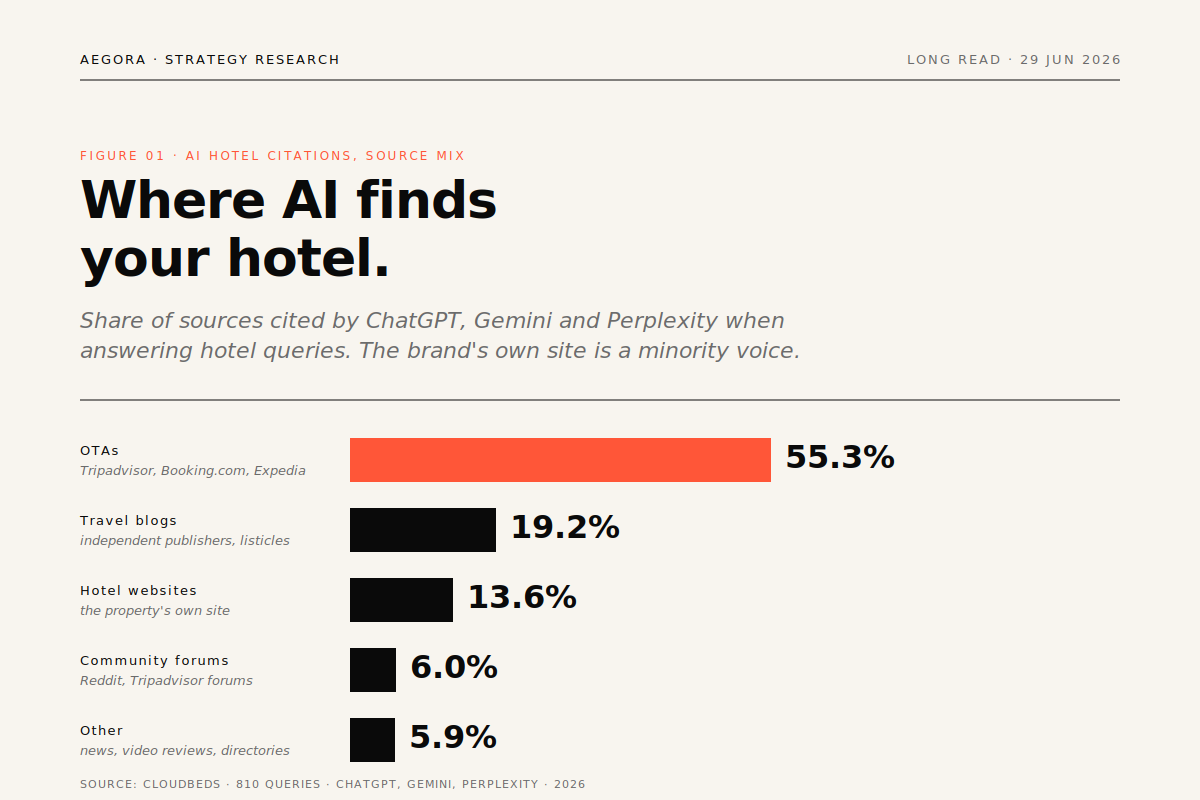
A useful nuance: hotel-owned websites accounted for 13.6% of citations in the hospitality context, above the roughly 9% average observed across other industries. Hospitality fares better than consumer-packaged-goods. McKinsey's June 2026 State of the Consumer report, drawing on the XEO360 dataset, found that brand-owned websites accounted for between 1% and 2% of cited sources when AI engines answered brand queries in CPG categories.4 The two methodologies are not strictly like-for-like, so the contrast is illustrative rather than definitive. Hotel websites are not invisible to the models, in other words, but they are still heavily out-cited by the OTAs, review platforms and travel publications that dominate the source mix. The brand's own description of itself is a minority voice in the answer the guest hears.
The brand's own description of itself is a minority voice in the answer the guest hears.
A related concern, frequently raised by hospitality technology vendors and generative engine optimisation specialists, is information consistency. When a language model cross-references multiple sources about a single business and encounters contradictions, such as different room counts between Booking.com and the property's own website, conflicting amenity descriptions across Tripadvisor and Google Business Profile, or inconsistent pricing or operating terms across platforms, the model has fewer confident anchors from which to build its answer. Specialists serving the hospitality sector commercially argue that inconsistencies make a property less likely to be cited at all, on the logic that a model facing contradictory facts has more reason to omit a business than to risk generating an error.5 The effect has not been quantified in a published experiment, and the vendors making this argument also sell services that address it. The practical implication, however, holds in either case. Consistency of basic information across every platform the business appears on, including name, address, room count, key amenities, descriptions, pricing structure and operating policies, is widely cited as the entry-level fix. It is also the least glamorous, and is correspondingly often deferred.
There is academic work on what changes a brand's likelihood of being cited. Researchers at Princeton University and IIT Delhi, in a paper presented at the ACM SIGKDD conference in 2024, ran 10,000 queries against commercial generative engines and tested nine content modification strategies. They found that adding quotations, statistics and explicit source citations to content could increase visibility in AI-generated answers by up to approximately 40%. Strategies that worked well in classical search engine optimisation, including keyword density, underperformed the baseline.6 The study was not hospitality-specific, and translating its findings to a single boutique property requires interpretation: a hotel does not publish statistics in the way an academic page might, but it does have raw material (occupancy patterns, guest testimony, named press coverage, structured amenity data) that models can credibly cite if it is made visible in the right way.
A second finding should unsettle operators who have built their digital presence on Google ranking. BrightEdge, an enterprise search platform, has tracked AI Overview citations against organic search positions for 16 months. They report that only about 17% of citations in Google's AI Overviews come from content ranking in the top 10 organic results. Approximately 83% of citations come from pages outside the top 10, with a substantial share from pages between positions 11 and 100 and another large share from pages that do not rank in the top 100 at all.7 Ranking number one on Google for "Bali wellness retreat" does not guarantee citation in the AI-generated answer to the same question. The two systems are reading different signals.
There is, finally, a quality problem in the underlying source material. Tripadvisor's 2025 Transparency Report disclosed that the platform removed approximately 214,000 reviews in 2024 that it had reason to believe contained AI-generated text, across 101,411 properties in 189 countries.8 The source set the models draw on is becoming more polluted, not less, and the consequence is twofold: models may summarise content that should not have been there, and they may also hallucinate amenities or policies that exist nowhere in the source material when the genuine record is thin.
Where premium operators in Southeast Asia are exposed
Premium operators face four kinds of exposure under the current mechanics.
The first is invisibility. A boutique property that has never thought systematically about how it is represented across OTA listings, review platforms, travel publications and aggregator sites may not appear when a high-intent guest describes its category in an AI prompt. The likelihood of this exposure rises with the precision of the query. A search for "best hotels in Bali" will surface obvious names. A search for "design hotel near Uluwatu with a serious coffee programme and quiet rooms" is a far harder filter.
The second is misrepresentation. When the property does appear, it does so through a description assembled from sources the operator did not write and may not have read. A wellness retreat positioned around silent meditation may surface as yoga and surf. A property of Aman-equivalent quality may appear as a generic luxury hotel in Bali. The model is summarising what the corpus contains, and the corpus is dominated by content the property does not control.
The third is competitive disadvantage relative to chains. The Cloudbeds finding that 72.4% of AI hotel recommendations go to branded properties is striking, but it should be read carefully. Chain properties already dominate traditional search results, OTA placement, Tripadvisor's algorithmic surfacing and the corpus of media coverage from which language models learn. AI may simply be reproducing an existing pattern rather than creating a new one. The honest question for an operator is therefore not whether AI introduces a disadvantage that did not exist before, but whether the new channel makes an existing disadvantage harder to see and harder to influence. The structural facts that produced the 72.4% in the first place, namely chain advantages in multi-property descriptions, structured booking feeds and consistent identity across hundreds of platforms, are still there. What changes is that the operator now has less direct ability to write the description a guest will read, since the property's own site is one of many sources rather than the primary one. Whether this constitutes a fresh exposure or an old one made more opaque is a question the available evidence cannot yet settle.
The fourth is margin. If a guest is led to a property primarily through a Booking.com or Expedia citation in an AI answer rather than through the property's own site, the booking is more likely to flow through the OTA channel and incur its commission. For independents that have spent years building direct-booking volume, this is not only a visibility shift but a margin shift. The dominance of OTA sources in the AI citation mix points to a structural redirection of the discovery funnel back toward intermediaries that operators have invested heavily to disintermediate. The visibility problem and the unit-economics problem are linked.
The picture is not uniformly negative for independent operators. A reasonable counter-reading of the evidence is that language models, because they match guests to properties through semantic descriptions rather than ranking lists, may eventually reward the kind of distinctive, narrowly defined identity that boutique properties cultivate and chain properties cannot. A property with a clear story, a coherent voice across the platforms it appears on, and a steady stream of detailed third-party coverage may be better positioned for the long-tail queries on which premium hospitality decisions are actually made than for the generic queries that dominate current AI usage studies. This possibility runs in the opposite direction from the chain-dominance finding cited above, and the available evidence does not yet show which dynamic will prove stronger. AI discovery is unsettled rather than settled, and the operators best placed to benefit from whichever way it resolves are those who have understood their current representation and acted on what they find.
A reasonable objection to all of this is that AI discovery does not yet drive enough bookings to justify operator attention, and that managing it should wait until the commercial significance is clearer. The objection is fair on its own terms but underestimates how discovery shifts have historically worked in this sector. Google's effect on hotel discovery was visible to anyone watching by 2003, but the booking consequences for properties that had not adapted did not become severe until later in the decade. Tripadvisor reshaped consideration before it reshaped conversion. Instagram changed inspiration patterns for years before its impact on premium hospitality bookings was measurable. The pattern in each case was the same: a discovery channel became materially important before its effect on commercial outcomes was easy to count. By the time the booking effect was unambiguous, the operators who had ignored the discovery shift were several years behind those who had not. Whether AI follows the same trajectory or stalls is uncertain. What is more certain is that an operator who waits for the booking data to settle the question will be late to act on what the data eventually shows.
Exposure profiles also vary across the verticals our work covers. Hotels and resorts have the deepest evidentiary base because of studies like Cloudbeds, and they have the richest third-party source set from which models can draw. Restaurants depend on reservation platforms (Chope, OpenTable, Resy) and visual platforms (Instagram, TikTok), and the models' treatment of these sources is less well understood. Wellness retreats and longevity clinics sit at the most exposed end: the third-party source set they depend on is smaller and less standardised, and operators in this category often have minimal presence on the structured platforms that models seem to favour. Public research on AI discovery in these adjacent categories is sparse. The Global Wellness Institute has launched an AI Wellness Initiative but has not yet published quantitative work.9 Restaurant platforms have launched AI concierge tools without releasing consumer survey data.10 Most operators in these categories are operating with no visibility into how AI is representing them, in markets where the underlying tooling is being built quickly.
One more thing worth stating plainly. The mechanics described above hold for the system as it functions in mid-2026. The major models are evolving rapidly, and the citation patterns observed today will not necessarily hold in 12 months. Operators should treat any diagnostic of their current AI representation as a snapshot rather than a permanent finding, and any work that follows from it as a continuing discipline rather than a one-time fix.
What this means in practice
The first useful question for any operator in this category is not what to do about AI discovery. It is what the model is actually saying about the property right now, and how that compares to its direct competitive set.
Aegora is developing a structured AI discovery diagnostic for premium hospitality, wellness and food operators in Southeast Asia. The method runs a set of queries that match how a guest would describe the property's positioning, across the three engines that account for almost all AI-driven traffic. It maps which third-party sources the models are leaning on, where the property is absent or misrepresented, and how the competitive set is being described. The output is a diagnostic. The work that follows is a separate engagement and involves narrative, content and platform discipline rather than a one-time technical fix.
The diagnostic is at an early stage. Operators experiencing the visibility problem described here, or advisors who recognise it in the properties they work with, are invited to write to us with their observations. We are particularly interested in cases where a property's positioning does not survive translation through the major language models, since that is the gap the diagnostic is being designed to close.
To get in touch: hello@aegorastrategy.com or WhatsApp +62 812-4658-6471.
Sources & notes
- Expedia Group — The AI Trust Gap: travelers embrace AI for planning but rely on trusted brands to book (April 2026). Survey conducted by YouGov, 5,700+ adults across the United States, United Kingdom and India, fieldwork 10–25 March 2026.
- Kaspersky — Is AI underrated as a travel agent? (August 2025). Survey conducted with Toluna, 3,000 respondents across 15 countries including Indonesia and Malaysia.
- Cloudbeds — The Signals Behind Hotel AI Recommendations (2026). 810 automated queries across ChatGPT, Gemini and Perplexity, 145 upscale properties, six destinations: Banff, Bangkok, Barcelona, Cancun, London and New Orleans.
- McKinsey & Company — State of the Consumer 2026 (June 2026). XEO360 dataset analysing approximately 2.6 million citations across ChatGPT, Gemini and Perplexity, October 2025 to May 2026.
- Asksuite — GEO for hotels: how to get ChatGPT to recommend your property (February 2026). Practitioner guidance on information consistency and AI citation behaviour from a hospitality technology vendor; presented as practitioner consensus rather than experimental finding.
- Aggarwal et al. — GEO: Generative Engine Optimization (KDD 2024, arXiv 2311.09735). Princeton University and IIT Delhi; 10,000 queries against commercial generative engines testing nine content modification strategies.
- BrightEdge — AI Overviews at the One-Year Mark: presence, size, and what they're citing (February 2026). 16-month tracking of AI Overview citations against Google organic rankings across nine industry verticals.
- Tripadvisor — 2025 Transparency Report (March 2025). 214,000 reviews containing AI-generated text removed in 2024, across 101,411 properties in 189 countries; 79.7 million total contributions and 31.1 million reviews processed.
- Global Wellness Institute — AI Wellness Initiative. Initiative page; no quantitative survey on AI discovery of wellness retreats published as of June 2026.
- OpenTable — Concierge launch (July 2025). Generative AI assistant launched across 60,000 OpenTable restaurants; no consumer survey data on diner use of AI for restaurant discovery published.