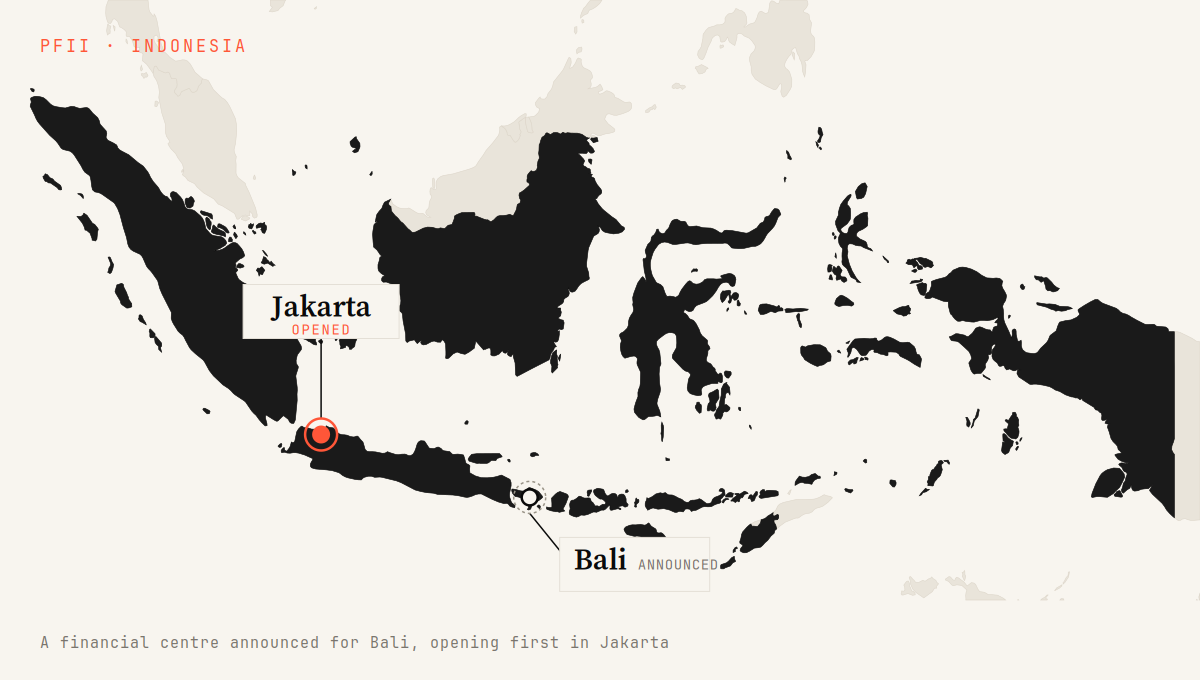
On 14 August 2026, while presenting the 2027 budget to parliament, President Prabowo Subianto told the country where Indonesia's new international financial centre would be built. His words, as recorded in the official transcript and matched by the print and wire coverage, were these: "Today I announce the planned location of the Indonesia Financial Center, or Pusat Finansial Internasional Indonesia, abbreviated PFII. We have determined the temporary location of the PFII in Jakarta, and when possible we will also open the PFII in Bali, and perhaps there will be other areas."
The word worth pausing on is "temporary." For four months, this had been a Bali story: back in early May, the coordinating minister for economic affairs had toured a special economic zone on Serangan Island, just south of Denpasar, and named it as a possible home for a financial centre modelled on Dubai. The finance minister mentioned a zero percent tax rate in the same week. Through June and July, Indonesian coverage kept describing Bali as the country's answer to Dubai. And yet, by the time the president stood up in parliament, the centre had become something rather different: an institution that would open first in Jakarta, in an existing office building, with Bali reduced to a later phase rather than the decision it had seemed to be.
That distance between what was announced and what actually exists is what this piece is about. The legal framework for the centre was assembled at remarkable speed, and it is more serious than its critics allow. Its incentives point clearly at wealthy individuals and families, not at the banks the Dubai comparison implies. The long search for a Bali site failed because a financial centre needs far less land than the government seemed to think. Serangan, the zone that lost the prize, may turn out better off for having lost it, though only if it can solve problems that have nothing to do with finance. Behind all of it sits the question that matters most for the island, which is whether Bali gets anything real out of any of this.
A law passed in eighteen days
The financial centre stands on two laws. The first came in June: an amendment to Indonesia's 2023 financial sector law, promulgated on 17 June 2026 as Law No. 4 of 2026, which set a deadline of three months for a second, dedicated law to follow. The second is that dedicated law. It entered parliament's priority legislative programme on 2 July, went through public hearings on 6, 8 and 9 July, was worked through committee between 13 and 20 July, was agreed at committee stage on 20 July, and passed the full chamber on 21 July. Kompas, counting the working days, described the bill as debated for eighteen days before it reached the floor.
A month after parliament passed the law on 21 July, it had still not been given a number or entered into the State Gazette, the register that makes an Indonesian law formally citable. This is partly a matter of ordinary procedure, since a bill approved in a plenary vote is only numbered once the president signs and promulgates it. But it does mean the president announced where the financial centre would open while the law creating it was not yet, in the fullest sense, on the books.
What the law sets up is more substantial than the speed might suggest. It creates a whole institutional structure at once: an advisory council, a governing council, a management agency led by a governor, a financial supervisor specific to the zone, an arbitration body, and a dedicated court. Inside the zone, English can be used for contracts, court hearings and judgments. Most strikingly, the zone is designed to adopt common-law commercial principles, the case-based legal tradition used in London, Singapore and Dubai, even though Indonesia's national legal system is built on civil law, the code-based tradition it inherited from the Dutch. The law allows ad hoc judges to be drawn from the best legal talent in Indonesia and abroad, foreign citizens included. Taken together, this borrows heavily from Dubai's financial-centre model.
The criticism began within hours of the vote. Indonesia for Global Justice, a research group that follows trade and investment policy, went after the process itself, arguing that a law rearranging the country's financial architecture had no business being finished in under a month, and asking whose interests were served by that kind of haste. The economic research institute CELIOS raised a more technical objection: Indonesia is currently trying to join the OECD, the club of mostly wealthy economies, and OECD membership rewards financial transparency, so building a zone with deliberately lighter disclosure rules works against that goal. CELIOS put it more bluntly still, calling the package a potential shelter for tax evaders and untraceable money. And a constitutional law scholar, Andi Sandi Antonius, pointed to the sharpest legal problem of all: Indonesian judges are required to be citizens who have sworn an oath to the state, so a court that seats foreign judges runs straight into the constitution's idea of who is allowed to hold judicial power.
The government's response tells you something, because it shows a project being adjusted while under attack rather than simply defended. In his address, the president was specific that the new court would sit underneath the existing Supreme Court, inside the national judicial system rather than off to one side of it. That is the more cautious answer to the sovereignty objection, and also the weaker one, since a court folded into the national system has less of the independence that makes places like Dubai's courts trusted. The president also promised, without being asked, that the zone would still enforce anti-money-laundering rules, still require companies to disclose who really owns them, still collect taxes, and still share information with other countries' tax authorities. A government does not usually add a paragraph like that to a budget speech unless the criticism has already landed and it feels the need to answer.
The incentives are designed for a wealthy family, rather than a bank
Read the incentives as a single list and ask which kind of customer they suit. Corporate income tax set at 0% for as long as fifty years, according to briefings before the president's address. A firm guarantee that money and profits can be moved in and out freely. Golden visas, meaning long-term residence permits granted in exchange for investment. The chair of parliament's finance commission, Mukhamad Misbakhun, speaking after the address, added more to the list: expatriates who would pay no personal tax, and even, he suggested, the possibility of dual citizenship, something Indonesian law does not currently allow for adults and which would need a separate law of its own. The financial centre law itself lists family office management, the business of managing a single wealthy family's fortune, right alongside banking and capital markets. And in the market commentary around the announcement, the centre was described in the same breath as family offices, treasury centres and golden visas.
To see why that list points where it does, you have to set it against a change in the international tax rules that most people outside the field have never heard of. In recent years, most of the world's major economies agreed on a global minimum tax. The rule is straightforward: if a large multinational company, one with revenue above roughly €750 million, pays less than fifteen percent tax in one country, another country where it operates is now allowed to collect the difference. Indonesia adopted this rule at the start of 2025. So if such a company sets up in the Bali centre and pays zero percent, it does not actually keep the saving. Indonesia itself can charge a domestic top-up to bring the rate back to fifteen percent, and if it chooses not to, another government where the company operates is entitled to collect the difference instead. Either way the saving disappears. For the tier-one global banks and asset managers that the Dubai comparison brings to mind, the ones large enough to clear that €750 million line, the headline zero percent rate is close to meaningless.
This does not mean no institution would find the centre attractive. Below the global-minimum-tax threshold sits a large field of smaller players, mid-market private equity, regional asset managers, specialist funds, venture firms, for whom a 0% rate paired with common-law courts is a real draw. The point is narrower and it holds: the incentive that would anchor a genuine hub, a rate the biggest institutions actually feel, is the one the tax rules cancel out, while the incentives that survive intact, and the ones parliament keeps adding to, are aimed somewhere else.
For wealthy individuals and family offices, the picture is completely different, because that global minimum tax applies to large companies, not to people or to the private vehicles that manage family wealth. For them, a zero percent rate is a real and substantial benefit, and the golden visa, the tax-free expatriate status and the talk of dual citizenship all point in the same direction.
There are two honest ways to read this. One is the government's stated ambition, a genuine international financial centre that uses Dubai-style legal architecture to attract banks, capital-markets firms and other institutions over time. The other is the proposition written into the incentives themselves, which is to attract internationally mobile wealthy individuals and their capital first, by combining tax breaks, residence rights and lifestyle. These are not mutually exclusive, and they may even run in sequence, since a new jurisdiction plausibly needs a resident pool of capital before it can build a professional ecosystem around it. But the two are not equally far along, and that is where we come down. What Indonesia has actually produced, quickly and at little cost, is the legal shell, plus a set of incentives whose surviving benefits fall to individuals. What would make it a real hub is the harder inventory of trusted institutions and specialist talent, and none of that is built or quick to build. On the evidence available today, this is a wealth-residency proposition wearing the architecture of a financial hub, and the burden is on the government to show the hub is more than architecture.
The coordinating minister, Airlangga Hartarto, said as much himself, perhaps without meaning to. Asked on 10 July why Bali had been chosen at all, he did not talk about deep capital markets or a supply of financial talent, the things you would normally cite for a serious financial hub. He talked about the way of life. A financial centre, he said, is also about lifestyle, and about a lifestyle that is relatively calm and uncrowded, and what Indonesia was offering was the sort of thing Dubai offers in its quieter neighbourhoods. A parliament floating citizenship, a minister selling peace and quiet, a tax break that only the smaller institutions can bank: the paperwork describes an institutional hub, and the incentives describe a pleasant place for wealthy families to keep their money, and sometimes themselves.
We had reached a version of this conclusion weeks ago, but only by inference, working backwards from the kind of buildings going up on Serangan. The government's own statements since then have made the inference unnecessary.
The government spent four months looking for land which it did not really need
From where the Jakarta announcement leaves things, the long search for a Bali site starts to look like a misunderstanding of what a financial centre actually is, and the decision to open in a Jakarta office building looks like the moment the government corrected itself.
The government's own position kept moving, so the sequence is worth following. In May, the Kura-Kura Bali special economic zone on Serangan Island was the leading candidate the government discussed in public, and its developer, a company called PT Bali Turtle Island Development, presented its Knowledge District as a strategic site for a financial zone. By late June, the coordinating minister was speaking of two or three possible spots on the island rather than one. In July, the new law added a rule that the financial centre could not sit inside an existing special economic zone at all, which ruled out Kura-Kura in its current form; around the same time the finance minister, who under the law is the one who actually decides the location, told reporters he did not know the Kura-Kura zone, noted that it was a KEK and therefore ineligible, and remarked that a zone's special status could always be dissolved if it came to that. His own list of candidates by then included North Bali, Sanur and Kura-Kura. Then, on 11 August, the coordinating minister named yet another option: land near Ngurah Rai airport managed by InJourney, the state-owned tourism and airports company. Three days after that, the president announced that the centre would open first in Jakarta, on a temporary basis, and then in Bali once a site there was ready. The Jakarta home had in fact been settled weeks earlier: in late July, Danantara's chief executive, Rosan Roeslani, had named the building directly, the Danareksa Tower, a new office block owned by the sovereign wealth fund, to be used while the Bali site is prepared over the next two to three years.
Each of the Bali candidates falls apart on closer look, for different reasons in each case. Sanur's zone is small, 41.26 hectares, and under its founding regulation it is legally dedicated to medical and wellness tourism. Bali International Hospital is already operating there, with hotel and wellness facilities around it. It has neither the room nor the legal freedom to become something else. The airport option carries a longer history that tells its own story. InJourney's property arm was created back in 2012 specifically to build an "airport city" on the company's land around Ngurah Rai, and in the thirteen years since, what it has actually managed to build there is modest: a couple of hotel-apartment blocks, a private-aviation terminal, an aircraft maintenance facility, a warehouse park and a single office building. Its one large empty parcel, about 31 hectares at a place called Teluk Kelan in Tuban, was put out to potential partners in 2021 with a plan for a leisure park, resort villas and an outlet mall, and no development has visibly followed. That parcel also sits on the edge of Benoa Bay, where a proposed land reclamation triggered years of the largest environmental protests in Bali's recent history before the bay was designated a marine conservation area in 2019. It is difficult to imagine a government choosing that particular shoreline for a project meant to showcase legal calm and certainty.
Kura-Kura, for its part, was ruled out several times over. The new law barred it. The provincial legislature has an unresolved dispute with its developer over planning and permits. The developer is a private company that was the subject of a bankruptcy petition, filed in 2010 by the Japanese contractor Penta Ocean over an unpaid debt, as reported at the time by Hukumonline. Against that sits a plainer commercial fact. Danantara, the country's sovereign wealth fund, has emerged as the investment partner scouting the Bali sites, and the coordinating minister has toured state-owned land near the airport alongside Danantara's chief executive as potential locations. When a state fund is helping to pay for a national flagship, it naturally prefers to build on state-owned land, so that the rise in that land's value stays with the state rather than flowing to a private developer. Once the money was going to come partly through Danantara, in other words, the choice of site was always going to drift away from a private island concession and toward land the state already owned.
Underneath all these particular reasons lies a simpler one that explains the whole episode. A financial centre is two different things at once, and they have very different footprints. One is a legal jurisdiction: a company registry, a licence to operate, a tax status, a court to settle disputes. That part is small. It fits inside a single office building, which is exactly where Indonesia has now put it, and companies will register in the Bali centre much as they register in Labuan off Malaysia or in the British Virgin Islands, through lawyers, without anyone coming there in person. The other thing is an economic ecosystem: the concentration of banks, asset managers, lawyers, accountants, arbitrators and counterparties whose physical proximity is what makes a mature centre like Dubai or Singapore actually work. That part is large, and it cannot be legislated into being or squeezed into one tower. It has to accumulate, over years, in a place people and firms choose to be.
That gap between the two is what the four-month land search was really about. The government was not looking for somewhere to put a registry; a registry needs almost no room, as the Jakarta decision concedes. It was looking for the physical home of a clustered financial district, the DIFC-style hub of towers and trading floors its own Dubai comparison keeps invoking. That is a genuine real-estate undertaking, and it is the part that ran aground on Bali, on the KEK rule, the provincial dispute, the environmentally fraught airport shoreline. Faced with that, the government did the only fast thing available: it opened the legal jurisdiction in the Danareksa Tower, a building the sovereign wealth fund already owned, and left the harder question, where the ecosystem clusters, unanswered. That the temporary home is a Danantara asset is not incidental. It is the same logic that pulled the site away from a private island concession in the first place, the state fund building on the state's own ground.
A registry can be signed into existence in a single office. The market of banks, lawyers and counterparties that gives it any value has to be built the slow way, and no lease delivers that.
Serangan may be the winner precisely because it lost
Which brings the story back to the island that was passed over.
Set the financial centre to one side for a moment and look at what actually happened on Serangan this year. On 31 July, a large open-air shopping district called Sira Village opened its doors: an investment of around 1.5 trillion rupiah, roughly 85 million US dollars, spread across nearly five hectares, built as a partnership between the local developer and Japan's Mitsubishi Estate, with more than a hundred brands and, eventually, about a thousand jobs. An international school, ACS Bali, is already running. A marina designed for around 150 berths is under construction. Villas, apartments and five-star hotels are marked out in the zone's master plan as slots waiting for developers to fill them. By the first quarter of 2026, on its own figures, the zone had drawn about 1.62 trillion rupiah of actual investment and created over 2,100 jobs, a steady and unhurried pace measured against a development plan that runs for decades.
Every one of those assets was planned long before anyone mentioned a financial centre. They come from the zone's founding regulation of April 2023, PP 23/2023, which establishes it as a 498-hectare tourism and creative-industry zone with marina, resort and education districts. The developer's own materials present Serangan as a residential and cultural destination, not a financial one. The financial centre was an idea that arrived from Jakarta in 2026, sat on top of the existing plan for a few months, and has now moved on.
Meanwhile, the zone's most serious problem has nothing to do with any of this. TPA Suwung, the largest landfill in Bali, sits right on the road that leads to Serangan, and it was ordered shut for good on 1 August 2026, after earlier closure dates in 2022 and 2025 came and went unmet. Whether this latest deadline actually held is, as we write, genuinely unclear, and the reporting conflicts: one account describes the closure being enforced from early August, another describes pressure to keep the site open longer. The replacement is a waste-to-energy plant whose operator, the Chinese firm Zhejiang Weiming, was appointed by Danantara, the same fund now central to the financial-centre plan. Such plants typically take around two years to build, which points to a gap of roughly that length between the old landfill closing and the new system running. Bali generates several thousand tonnes of waste a day, and reports of open burning and illegal dumping have already begun rising as the old system is squeezed shut before the new one exists.
Most of the coverage has read this as Serangan losing. It is closer to the opposite. The prize Serangan spent four months chasing turns out to be something that can be delivered from a Jakarta office tower. The business Serangan already has, the marina and the school and the shopping and the villa land, cannot be delivered from anywhere else, and it holds its value with or without the financial centre. The island is building for a demand that already exists, wealthy people who want to live, moor a boat and school their children in Bali, whether or not any of them ever registers a company in the PFII. Its plans were never staked on hosting the centre in the first place.
That is why losing the designation reads as an advantage. If the financial centre stalls, as plenty of Indonesian projects do, Serangan loses almost nothing, because its development plan was never built on the centre in the first place. And if the golden visas and tax-free expatriate status do succeed in drawing internationally mobile families who want to actually relocate to Indonesia, and that is a real if, examined in the next section, then Serangan is unusually well placed to compete for them: a 498-hectare master-planned island twenty-five minutes from the airport, with a marina, an international school, a retail district and villa land ready for building. The financial centre is an option for the island, not a customer pipeline it is counting on. Its physical assets were always worth more than the label, and losing the label may even spare it a decade of being measured against Dubai.
There is an honest qualification to make here. This more hopeful reading still depends on two things that are not yet settled: the developer resolving its dispute with the province, and the landfill transition not turning into a genuine waste crisis on the island's doorstep. A residential and lifestyle proposition can survive losing a financial centre it never needed. It would have a much harder time surviving two years of rubbish piling up on the only road leading inside.
The question that matters more than the building
The debate over where the financial centre goes is, we think, the wrong debate, and it is pushing a more important question out of view.
A financial centre, by itself, does not develop Bali, and the Dubai comparisons and zero percent tax rates tend to bury that. Because the centre needs so little physical infrastructure, and because a company can register there while its owners live anywhere in the world, setting one up guarantees almost nothing on the ground. An investor can incorporate a company in the Bali centre, enjoy every tax benefit on offer, and continue to live in Singapore, Dubai or Spain, never setting foot on the island for more than a holiday. Company registrations are not tourists, and they are not residents. They do not fill hotels, hire staff, send children to local schools or spend money in local businesses.
So the real challenge, and it falls more to Bali's provincial government than to Jakarta, is turning the advantages of a financial centre into advantages for Bali itself. That is a genuinely difficult task, and it is a different task from passing a law. It means finding ways to attract the people behind the paperwork: the individuals and families who might actually choose to base themselves here, and who would in turn support the development of places like Serangan, Nuanu, northern Bali, the long-planned InJourney sites, a possible new airport in the north, and other parts of the island that need investment and residents rather than registrations. Simply standing up another financial centre does nothing to guarantee that inflow of real people. Working out how to convert one into the other is the harder and more valuable job, and it is one that belongs to Governor Wayan Koster at least as much as to President Prabowo.
On that reading, the announcement of 14 August is less of a milestone than it first appears. It settles a legal question and leaves the important question untouched.
What would tell us this is becoming real
The government has changed the project in response to its critics, placing the new court under the Supreme Court and committing to keep the anti-money-laundering rules in force, and it deserves genuine credit for doing so. That credit belongs to the design of the institution, though, not yet to the institution itself. A rulebook shaped by feedback is a real achievement. Whether the centre is trusted depends on things a rulebook cannot deliver: whether its court rules consistently once it is operating, whether its contracts hold up when tested, whether it stays free of political interference over a long stretch of time. Indonesia has done the part that can be written down. The part that has to be demonstrated, year after year, has barely begun.
A few specific developments will tell us more than any further speeches.
The first is the choice of governor to run the centre. The coordinating minister has said a candidate already exists and comes "from within the government," without naming the person. Whether that job, and the first appointments to the new court, go to credible specialists or to political allies will be one of the earliest honest signals of how serious the project is.
The second is the implementing regulation, the detailed rulebook that has to follow any Indonesian law before it can actually function. In July the coordinating minister said the government would move fast and have this ready before 16 August. That date has now passed without it, and how long the rulebook actually takes will be a fair measure of how settled the project really is.
The third is the Bali site itself. The Jakarta home is settled, the Danareksa Tower, for a transition the government puts at two to three years. Where the permanent Bali centre actually goes is not. The candidates have shifted repeatedly, from Kura-Kura to Sanur to northern Bali to state land near the airport, and no site has been fixed. The day a specific Bali parcel is named and ground is broken on it is the day the Bali half of this stops being an aspiration and becomes a project.
A word of caution runs underneath all three. In Indonesia, the distance between an announcement and a working reality is often measured in years, and sometimes the reality never arrives at all. Even a formal appointment or a signed regulation will mean little until there is real activity on the ground. It is worth watching these signals, but worth watching them patiently, and treating each one as a small piece of evidence rather than proof that the thing is done.
For anyone running a business or weighing an investment in Bali, the practical conclusion is narrower and more useful than the headlines suggest. It would be a mistake to assume a financial district is about to appear on the island on any timeline firm enough to plan around. What actually matters for Bali is a separate question, and finance is only the starting point of it: can a company registry in Jakarta be turned into a reason for real people to come and live and spend in Bali? And if so, where on the island they would choose to do it. That competition is already underway, and it will be decided by real assets and by the goodwill of the province rather than by the wording of a law. On those terms, Serangan, the island that just lost the naming rights, is better placed than any other site on Bali.
Indonesia has done the fast part of this in eighteen days, which is the writing of a law and the offering of a tax rate. The slow part, which is building the trust, the institutions and the reasons for people to actually turn up, has barely started, and for Bali it is the only part that was ever going to matter.